
Your website should be an investment that attracts the right customers and ultimately pays off—the right customers will recoup your investment and bring in more business. So the real question we need to ask ourselves is: How much does it cost to build a website that will attract the right customers and help me sell my services and products?
Website Development Cost is one of the first questions almost everyone asks themselves when thinking about creating their own website. Unfortunately, it’s rarely the right question.
A website should be viewed as an investment in the growth of your business and company. A well-designed website attracts the right visitors, convinces them of your offerings, and eventually brings in new customers who recoup the initial investment and create added value for your company.
1. How much does a website cost?
A Quick Guide to Website Development Costs:
- Business card or mini-website (3–4 pages): €800–€1,600
- Business/service website (5–10 pages): €1,600–€3,500
- Online store (product catalog, shopping cart, payment options): €3,500 or more
- Custom (custom logic, integrations, complex systems): €5,500+
You can find our price list at this link
2. The most common concerns regarding price
- Fear of paying too much without a clear understanding of what the price includes.
- Comparing bids based solely on price, without considering scope, quality, and strategy.
- The blurred line between a basic website and a strategically designed website.
- Underestimating the long-term costs of a poorly designed website (poor UX, SEO, need for a redesign).
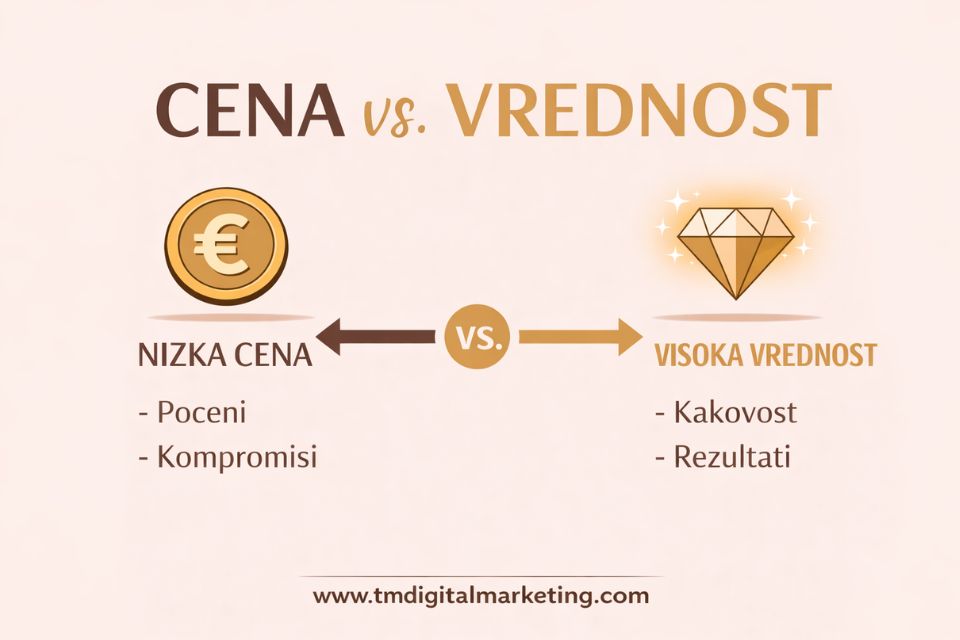
- “The cheapest solution” often means more compromises and, in the end, additional costs for repairs or remanufacturing.
The real question you need to ask yourself here is: what do I get, and how much will the website cost in the long run?
2.1 The varying needs of businesses, which directly determine the price
In fact, companies have different:
- Goals and needs (sales, presentations, blog posts, business cards…),
- Different scopes and content structures (number of subpages, text, photos, video libraries, and other multimedia),
- Various features required for their operations (reservation system, newsletter integration, e-commerce, payment system, etc.)
- Multilingualism of the website.
All of this directly determines the final cost of website development. Below, you’ll find a quick overview of what to look for when choosing a website developer.
3. Factors that influence price
Once you understand these factors, the price will make more sense to you.
3.1 Type of website
Whether it’s a simple website with just three or four pages serving as a business card or an online store, this can significantly affect the final price. Greater complexity and sophistication require more time to develop, more testing, and consequently a larger budget.
3.2 Design and User Experience
A website built using a template is quick to create and less expensive, but a custom-built website offers a fully tailored, responsive design—which is more expensive but also conveys clearer messages, improves readability, and consequently builds greater customer trust. All of this, of course, influences whether a website visitor will become a customer or buyer. In this way, the cost pays for itself as an investment.
3.3 Scope and Number of Subpages
Each subpage has its own structure, text, and visuals, and requires testing on various devices. The difference between five and fifteen subpages quickly translates into hours of work. Scope is one of the key reasons why the cost of website development varies from project to project.
3.4 Website Features and Application Integrations
Forms, a booking system, analytics, a site-wide search function, multilingual support, and clickable icons on the website that direct visitors directly to a message or a call. All of this contributes to making the site intuitive and functional; even though each feature may seem small on its own, they all add up in the end.
3.5 SEO Optimization and Content
Clear content, a well-thought-out heading structure, internal linking between different subpages, good service descriptions, and meaningful CTAs. All of this forms the foundation of an effective website. Combined with a high-quality technical foundation, a mobile-friendly version, and fast website speed—all of these factors enable better organic reach, thereby reducing reliance on ads and making the investment in website development more worthwhile in the long run.
Are you curious about the trends for 2026? Then check out the post Top Trends in Web Development in 2026.
4. What You Actually Pay When You Pay for Website Development
4.1 Strategy and Understanding Your Business
- Website Objectives
- Tailoring Content and design to reach the right users
- Structure of Content

4.2 Design and User Experience (UX/UI)
- Beautiful design—it’s not just about looks.
- Logical navigation: all elements and subpages of the website are logically interconnected to form a single cohesive whole. We never lose the user; they remain on your website at all times.
- Clear calls to action (CTAs), such as clicking on additional pages or purchasing a service or product.
4.3 Technical Implementation
- Speed and safety,
- Mobile flexibility
- Basic SEO structure
4.4 The Story of Your Company and Business
- A much more important factor than it seems at first glance.
- It positions you as an expert in your field, thereby dispelling any concerns about the price.
- Highlight the challenges your potential customers face and offer them solutions that will make them ready to purchase your service or product.
5. Estimated Cost Range for Website Development in Slovenia in 2026
Solutions tailored to specific business processes, featuring advanced functionalities, integrations with external systems, or fully customized development. Of course, there is no one-size-fits-all price, as it ultimately depends on what you want and what you need.
5.1 What will be the estimated cost of creating my website?
- Business card or mini-website (3–4 pages): €700–1,500
Suitable for a basic online presence for a company or individual. It includes a simple structure (Home, Contact, Services, About Me), a basic design, and contact options. - Business/service website (5–10 pages): €1,500–3,000
Ideal for businesses that want to clearly showcase their services, build trust, and generate leads. It typically includes a more thoughtful structure, UX, basic SEO setup, and customizations. - Online store (product catalog, shopping cart, payment options): €3,000 or more
The price depends on the number of products, the complexity of the features, payment systems, delivery, and integrations. Suitable for serious online sales. - Custom (custom logic, integrations, complex systems): €5,000+
5.2 How can you quickly calculate the budget for a website tailored to your needs?
Answer the 5 questions below to get an estimate of the cost of your desired website. Of course, the final price may still vary.
5 Questions You Should Ask Yourself Before You Start Building a Website
- What is the main goal of my website—simply to have an online presence, to generate leads, or to make direct sales? What do I need it for?
- How much content will the website have—how many subpages do I need, and are the text and visual materials already prepared?
- What features are essential for me—for example, a blog, multilingual support, custom forms, reservations, payments, or integration with a CRM system? Pop-ups for newsletter sign-ups, integration with social media channels, clickable icons for calling or contacting via email, …
- Which subpages are really necessary at the start—Home, About Us, Services, Blog, Testimonials, Contact, or anything else?
- What approach do I want to take with the design—using a template or a custom design tailored to my brand?
The answers to these questions will give you a price range. This is the quickest way to estimate how much it will cost to build a website in your specific case.
6. The Risks of Cheap Websites
A cheap website template may seem like a good choice at first glance, but it often comes with certain risks:
- a poor user experience and a poorly communicated brand story,
- an unclear and illogical website structure,
- limited or unreliable functionality,
- poorer search engine optimization and slower page loading,
- problems with future upgrades and customizations, and
- long-term additional costs for repairs, improvements, or, in the worst-case scenario, the creation of a new website.