
Web design trends aren’t an end in themselves; their main purpose is to create a website that works to the benefit of your business and company—a site that ranks well in modern search engines and clearly communicates who you are and why customers should choose you. Online competition is fierce and has long since surpassed the saying. If you're not online, you don't exist.
1. Strategy is more important than design
An effective website goes beyond just pretty colors and fonts; clarity is becoming an increasingly important feature.
A beautiful website is no longer enough; a website must be strategically designed so that it can be easily read by both people and LLM models (LLM – Large Language Models).
The clarity of the website comes from:
- Clarity regarding who the page is intended for,
- what problems the website solves and
- the next step the potential customer should take (a clear call to action).
In practice, this means that when someone visits your homepage, it’s immediately clear to them:
- What are you doing, what is your business about,
- who you help and how you help them, and
- how to take the next step (CTA).
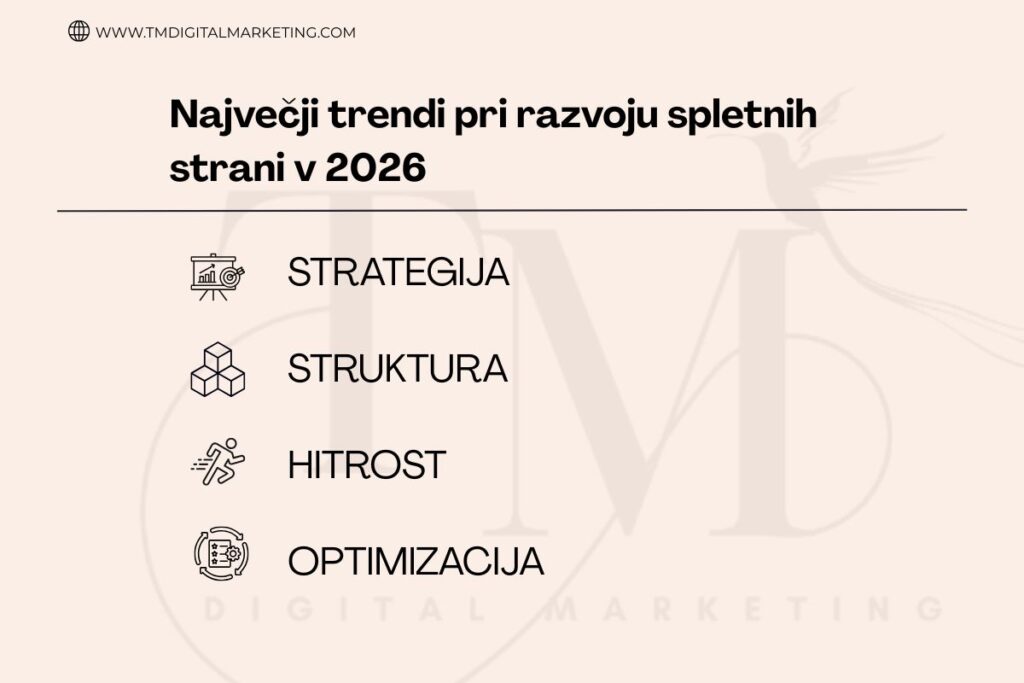
2. The page structure must be AI user-friendly
Artificial intelligence (AI) has transformed the way people search for information. As a result, your content is read not only by people but also by AI tools that summarize, recommend, and discover information.
Websites that work well are clearly structured with logical headings and sections and provide specific answers to specific questions.
There are fewer long pages with a lot of text; the pages are thoughtfully laid out, and the navigation and AI smoothly guide users through your content.
The following play a key role in this:
- Landing pages showcasing our services,
- Structured Frequently Asked Questions (FAQ) and
- Well-written and properly structured blog posts.
3. Web pages should be simple and fast
Page load speed is more important than ever! Not only does speed improve the user experience (UX), but it also significantly boosts search engine visibility.
Visitors expect a website to load quickly, look clean, and guide them smoothly through the content on all devices. Heavy websites, complex animations, and unnecessary plugins are losing popularity.
4. The human factor is once again gaining in importance
Although it is an undeniable fact that AI is playing an increasingly important role, the websites that stand out will still feel very human and personal. This is because LLM models are particularly fond of original content that offers fresh insights.
Stock photos from image libraries and text templates created using AI are very easy to spot—and just as easy to overlook. Companies that showcase their personality, use real photos, and adopt an authentic tone build trust more quickly.
5. Websites are living organisms
Imagine your website as a living organism that is constantly changing, observing the outside world, and adapting.
Effective websites are constantly evolving and improving. It is important to keep pace with both the growth and development of your business and changes in search behavior. Accordingly, your website should be reviewed, updated, and optimized.
This includes:
- Updating texts,
- Improving layouts and updating visual elements, and
- Optimizing content for search using the AI
Majhne in redne izboljšave pogosto prinašajo boljše rezultate kot velike prenove, ki se izvajajo na nekaj let.
Authentic and well-structured blogs that provide fresh content also remain a very important SEO tool.
Your website should work to your advantage, not quietly cost you opportunities. If your website hasn’t been reviewed or updated in a while, now might be the right time to change that.
If you need help reviewing or updating your website, we’d be happy to assist you.